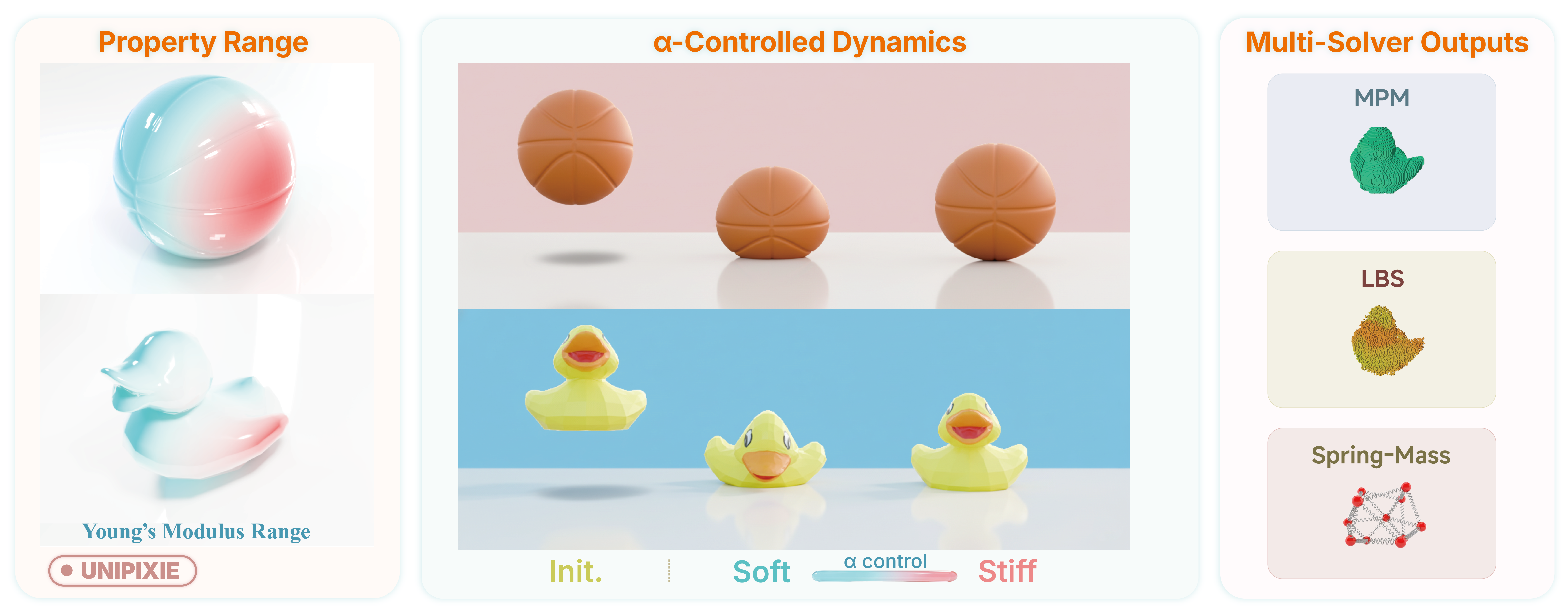
UniPixie generates a controllable soft-to-stiff spectrum of simulation-ready 3D physical parameters from visual input.
Existing feed-forward methods predict a single set of physical properties from visual appearance, but real-world physical behavior is inherently ambiguous. A visually similar object can be soft, stiff, or anywhere in between.
UniPixie reframes physics-from-vision as controllable generative modeling. Given visual input and a scalar control parameter α, UniPixie predicts a continuous soft-to-stiff spectrum of physically plausible material properties and produces simulation-ready parameters for MPM, LBS, and Spring-Mass solvers.
Experiments show that UniPixie reduces Young's Modulus prediction error by over 50% compared with the strongest deterministic baseline while enabling controllable multi-solver simulation.
Learns a continuous soft-to-stiff material spectrum instead of a single point estimate.
Provides physically plausible material property ranges for supervised generative physics learning.
Generates simulation-ready parameters for MPM, LBS, and Spring-Mass systems.
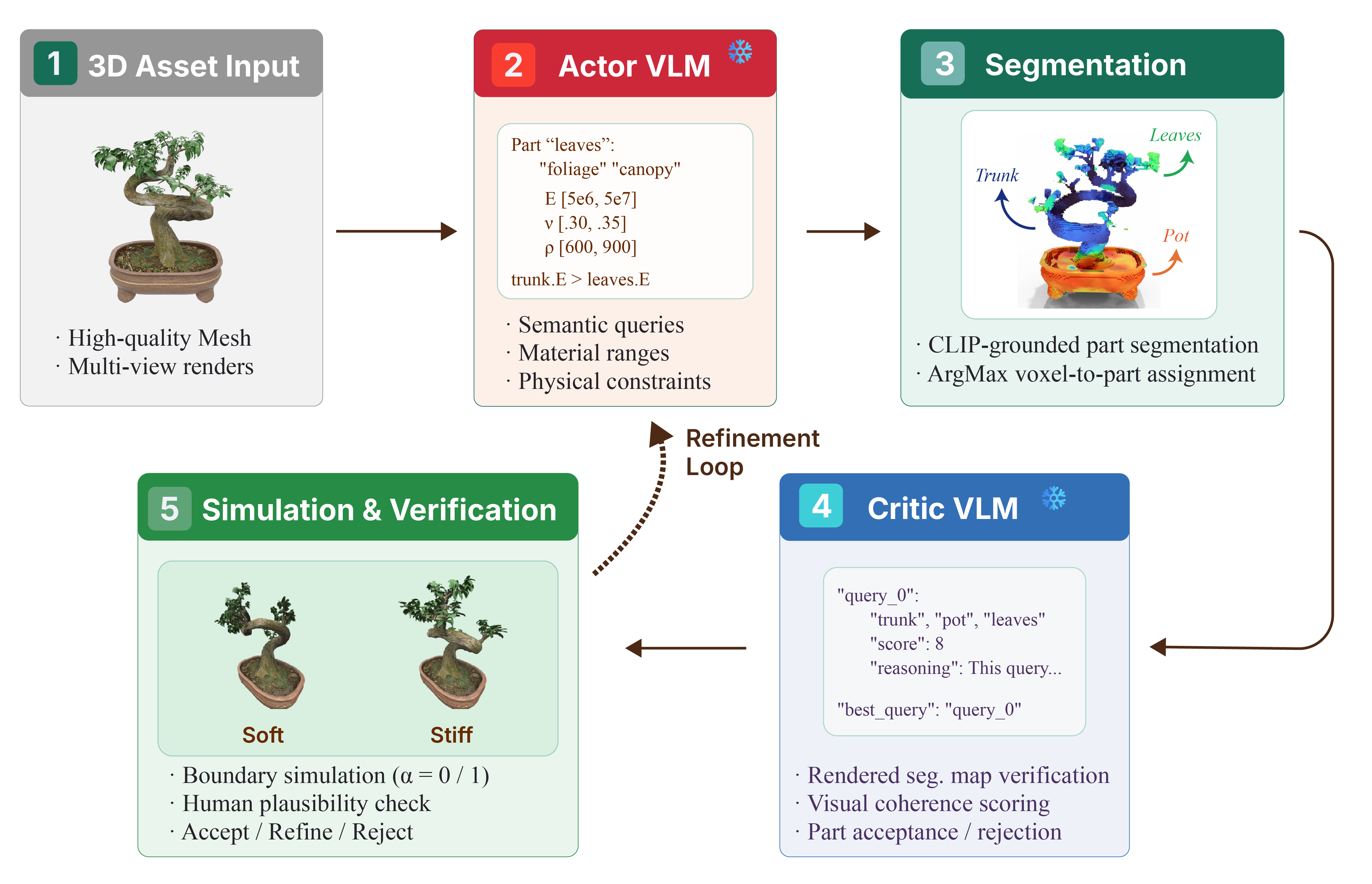
PixieMultiVerse annotates material property ranges through VLM-proposed constraints, CLIP-grounded segmentation, boundary simulations, and human verification.
A shared physics-aware latent representation is decoded into solver-specific physical parameters under α control.
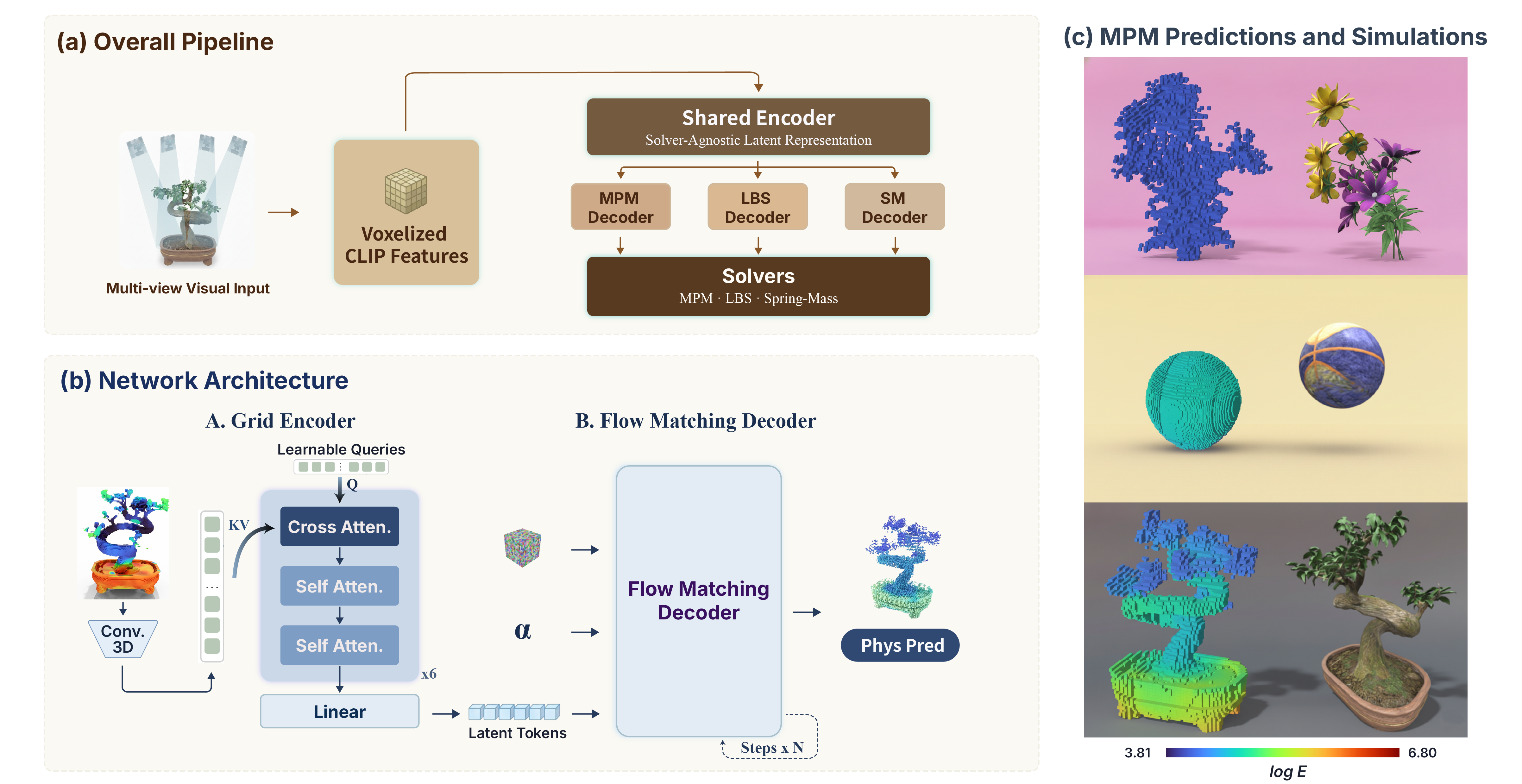
Multi-view visual features are lifted into a voxelized CLIP feature grid.
A unified grid encoder produces solver-agnostic latent tokens.
α-conditioned decoders generate MPM, LBS, and Spring-Mass parameters.
UniPixie improves continuous physical property prediction, supports multiple physics solvers, and generates controllable soft-to-stiff dynamics from the same visual input.
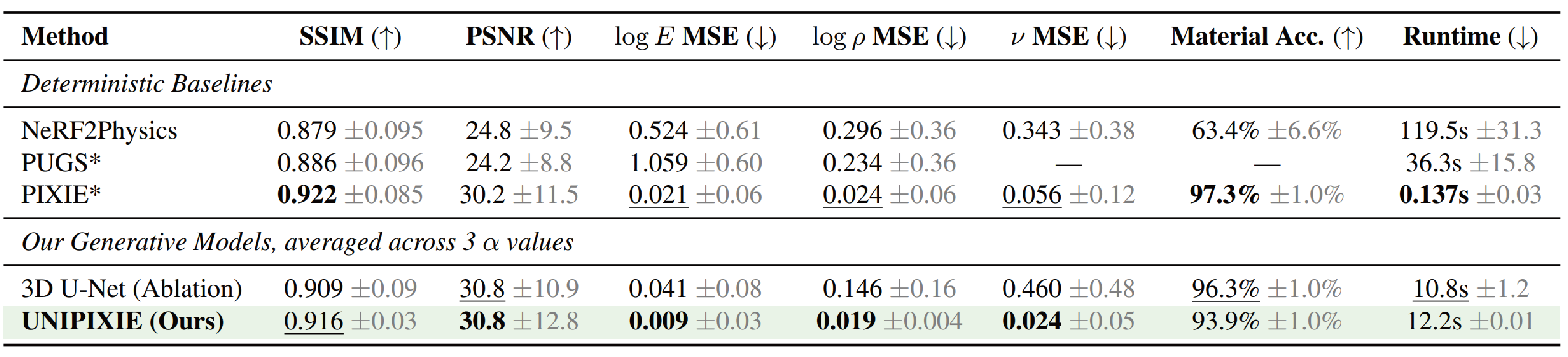
Insight. UniPixie achieves the best continuous property prediction, reducing Young's Modulus error from PIXIE's 0.0205 to 0.0091 while maintaining strong simulation fidelity.
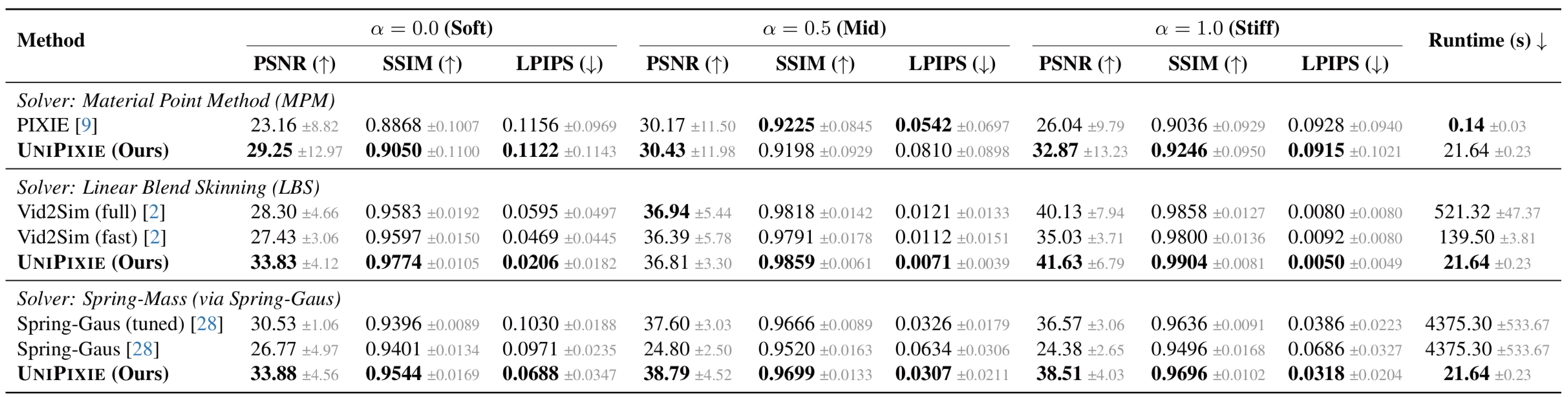
Insight. A single unified UniPixie model performs competitively or better than solver-specialized baselines across MPM, LBS, and Spring-Mass, while avoiding expensive test-time optimization.
We are preparing the code, model checkpoints, and dataset release. Please check back soon.
Coming soon after cleanup.
Release instructions will be added soon.
Checkpoints are being prepared.
@InProceedings{Huang_2026_CVPR,
      author    = {Huang, Qilin and Huynh, Quynh Anh and Le, Long and Wang, Chen and Chen, Chuhao and Lucas, Ryan and Eaton, Eric and Liu, Lingjie},
      title     = {UniPixie: Unified and Probabilistic 3D Physics Learning via Flow Matching},
      booktitle = {Proceedings of the IEEE/CVF Conference on Computer Vision and Pattern Recognition (CVPR)},
      month     = {June},
      year      = {2026},
      pages     = {19907-19916}
    }